
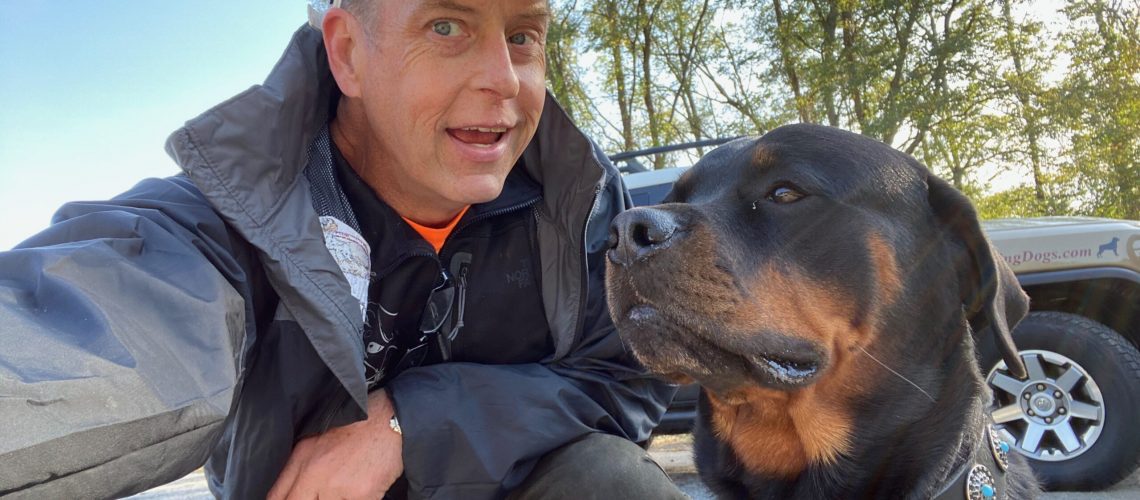
Here at Canine Behavioral Services, my approach to dog training is simple: work with the dog, not against them.
I don’t believe in force, intimidation, or quick fixes that merely suppress behavior without addressing the root cause. Dogs aren’t machines; they’re thinking, feeling animals that are shaped by their interactions with humans and their past experiences.
When the dog’s behavior breaks down, it’s not disobedience; it’s communication. The dog is NOT trying to be “bad”…they are confused and trying to communicate.
While the focus of Behavior Training is to CHANGE the dog’s behavior, the work done in Obedience Training tries to CONTROL the dog’s behavior.
From my perspective, Behavior Training and Obedience Training couldn’t be more different from each other.
In Obedience Training, the majority of the work is done to CONTROL the dog’s behavior. Unfortunately, by the time they’ve invested valuable time and money, most owners find out this type of training doesn’t actually work when they need it. Sure, the dog sits on command in the backyard with treats and no distractions, but all efforts to repeat this when guests come through the front door are unsuccessful.
This is just one common result that most owners experience in their Obedience Training efforts.
With Behavior Training, however, we do not work to CONTROL the dog’s behavior; instead, we guide the dog to choose the correct, desired behavior on their own. No ineffective verbal commands, no force or intimidation, no shock collars or pinch collars. Just natural Behavior Training communicated in a way that the dog clearly comprehends.
As a Certified Professional Dog Trainer (CPDT-KA), I use all-natural, force-free methods to build trust, clarity, and confidence. That means no shock collars, no harsh corrections, and no shortcuts that create more problems down the road. Instead, I rely on scientifically sound, proven behavioral strategies & principles, reward-based training, and structured guidance that helps dogs actually understand what’s being asked of them.
Every dog I work with gets a personalized training plan based on their history, temperament, environment, and stress levels. Whether it’s hyper-arousal, reactivity, anxiety, aggression, or just a lack of structure, the goal is always the same:
create a calm, thinking dog who can function confidently in the real world.
A big part of my work, and often just as important as training the dog, is teaching owners how to read their dog. The subtle signs matter. Things like lip licking, visible tension, avoidance, or overstimulation are early indicators that most people miss. When you learn to recognize and respond to those signals, everything changes. Training becomes proactive instead of reactive.
I also focus heavily on controlled exposure in real-life applications & environments. Dog behavior does not improve in chaos. It improves in structured, controlled environments where we can guide them through challenges at the right pace, working under threshold. From there, we gradually build their ability to handle the world around them without shutting down or escalating their arousal level.
For my team and me, this isn’t about obedience for the sake of control. It’s about creating clarity, reducing stress, and building a dog that thinks rather than reacts.
Because when you do it right, you don’t just change behavior…you vastly improve the relationship.